


Thailand Kayaking at it's best
|
Phi Phi Island Activities | Phi Phi Island kayak adventures compare with the best of Phu
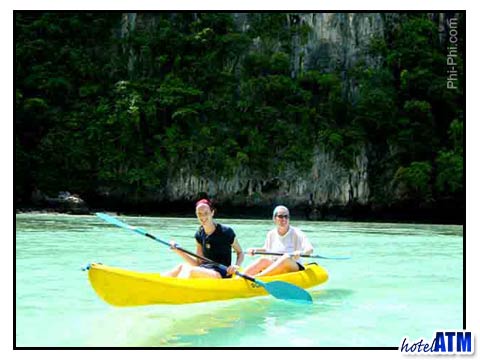
The tropical heat had done its worst and the most pleasant part of the day began. Well after the dive boats had returned from Phi Phi Ley and started to anchor off Tonsai Bay, a small quiet group formed in the shade of the Tonsai Towers, the cliffs running from the centre of the village to the end of the bay. By 4pm the 300m hills had begun casting their long shadows from the west and we would stay in shad for the next hour and a half. On Tonsai bay, Phi Phi Island the golden sand beach in front of the old Siam UK watersports centre was deserted of its customary legions of day trippers from Krabi. Under the coconut trees, four two-man ocean kayak waited patiently, ready for the afternoon adventure. Kayaking trip preparationOn the beach, Khun Nex, our thoughtful guide, carefully explained the trip ahead to Wang Long and detailed the hows and whys of kayaking and our route. After 10 minutes practicing the basic techniques and some fine-tuning of paddle strokes, our small band of Nex and seven customers pushed off into the turquoise water towards the base of the cliff under the famous climbers wall. The kayaks on Phi Phi IslandOcean kayaks are "sit-on kayaks" and are the ideal boat for open sea paddling. A strong boat that is difficult to flip and good in high wind and waves, the what-you-see-is-what-you get simplicity is perfect for our guests, 60% of whom have never kayaked before. The Start of our kayaking tour to Wang LongBelow the cliff, monkeys played on the beach, oblivious to the holiday makers at Tonsai Village Bungalows. Paddling no more than 3m from the Bamboo-covered cliffs, the fresh smell of oxygenated jungle contrasted with the smell of the foreshore just the other side of us. Being close to the cliffs gave a feeling of speed and the kayaks cut through the water faster than we could walk. Rocks and boulders off the cliff face created a fun zig-zag route through which to paddle. Arriving at Ao-Ling (Monkey Beach) the group pulled their boats up onto the beach . Here a few young longtail boatmen, mainly from Koh Jam and Koh Yao live in wooden huts and under the cave-like overhangs rather than pay for rooms in the village. Chatting together, they watched us explore the beach and rocks. We only paddled for about 10 minutes and the village, though only 800m away, glowed in the evening light and already appeared far behind. Off we went again, now paddling in a group, synchronizing our strokes as we found our natural rhythm. Two sea eagles were spotted hanging off the coral reefs in search of an easy dinner. One dived and swooped but we lost sight of them in the cliffs overhead. After 10 more minutes of same kind of scenery, we arrived at the first of three pencil-thin beaches. Bounded by sea and cliffs, these tiny strands are only 2m wide at high tide and are cut off from land. More monkey came down to squawk and shake the trees. We did not interrupt their evening festivities too long as we moves out to reef and tied up against one of the National Park moorings. Without fins, we swam over the reef which was surprisingly colorful and teeming with fish. After a rest, Nex led us up to a shear face in the corner of Hao Raogute bay and, to our surprise, the cliff parted at the entrance of a small enclosed lagoon. The “Tiger ‘s Mouth” is covered with ancient trees and climbing vines along the 100m cliffs. The beach has strange aerated sand, which we discovered as we sank up to our knees when we pulled our kayaks onto the beach. To read the rest of the article and find out how we got on at Wang Long click Thailand Kayaking at it's best continued
Photos for Thailand Kayaking at it's best
|
|
|||||||||||||||